


With margins tightening, interest rates rising, and agricultural volatility ongoing, financial management is more crucial than ever for farm operations. Nathaniel Watts, head of Ag Retail Credit with Farm Credit Mid-America, said understanding the basics of a balance sheet can give farmers a clearer picture of where their businesses stand and how to move forward.
Watts works with credit professionals across Farm Credit Mid-America, helping evaluate financial packages and provide credit insights to farmers. He has seen how recent market conditions are impacting operations across the region.
“It’s no secret that we’re seeing tighter margins, particularly on the grain side,” Watts said. “That is primarily driven by increased input costs, higher interest rates, and downward pressure on commodity prices. Ultimately, what that’s doing to a lot of financials for grain producers is causing a pretty significant squeeze in earnings and ultimately a squeeze on liquidity.”
As the next growing season approaches, Watts emphasizes the importance of reviewing balance sheets and using them to guide management decisions.
“I think for a lot of producers, a balance sheet is something their lender asks them to do on an annual basis,” Watts said. “And for a lot of producers, I think it’s more of a paperwork chore — something that they know they need to do.”
Watts said a balance sheet can serve as a valuable tool for understanding the financial outcomes of the past year.
“The balance sheet is really just an overall picture of the result of your operations all year,” Watts said. “If you earn money, your balance sheet will show where you deployed that capital into your operation. If you lost money, your balance sheet will show where that loss was absorbed.”
Looking closely at that information can reveal both strengths and areas where improvement may be needed.
“At the end of the day, the balance sheet kind of shows you where you’re winning and the parts of your operation where you might need to get better,” he said.
To help producers better understand their numbers, Farm Credit Mid-America has launched a new online resource called Balance Sheet Basics.
“We have rolled out a portion of our website that we’re calling Balance Sheet Basics, and it does a really good job of breaking these balance sheet principles down into really easy-to-understand pieces,” Watts said.
The resource includes videos, definitions, ratios, and sample balance sheets designed to make financial concepts easier to apply on the farm.
“There are some videos out there. They’re short, they’re to the point, but they really get at, here’s how you can put this into practice for your operation,” he said.
Watts said that when farmers take the time to understand their financial position, it can influence real management decisions.
“I talk with producers on a regular basis where gaining that understanding, increasing that financial acumen, and using those balance sheets to really understand where their operation is increases their confidence exponentially,” he said.
In some cases, that insight has led producers to delay major purchases while they monitor markets.
“A lot of the customers that I’m talking to right now have looked at their financial position, and they have made a decision to hold on to equipment maybe a little bit longer than they typically do,” Watts said.
Beyond short-term decisions, financial understanding also plays a role in the long-term future of family farms.
“When you think about generational farmers, how do we pass these family farms to the next generation?” Watts said. “The most important part of that is making sure that those operations are financially sound today.”
Ultimately, Watts said managing finances should be approached with the same attention farmers give to crop production.
“You can’t operate a strong farming operation without being able to produce bushels,” Watts said. “It would be like a producer putting out a corn crop in the spring, never looking at it, never checking on it, never doing anything with it, harvesting in the fall, not looking at any of the harvest data, not looking at any of the yield data, and then sitting down at the end of the year trying to make seed fertilizer and chemical decisions for the upcoming year.”
“All they would be doing is guessing. It’s the same thing from a financial management perspective.”
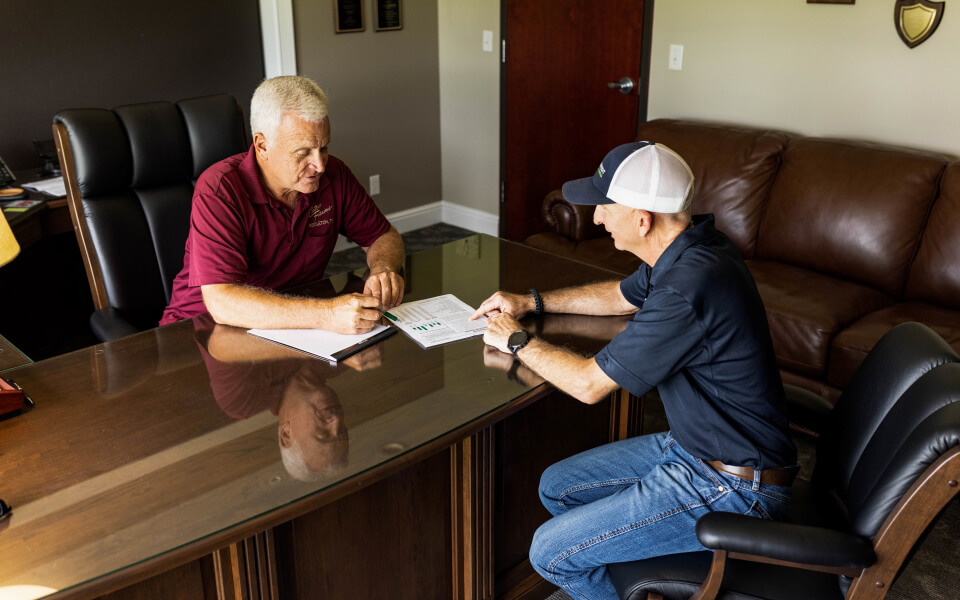
Watts’ advice to farmers who may feel uncertain about their financial situation is to build knowledge and work with trusted advisors.
“Work to increase your financial acumen. Find a trusted partner that you can sit down with. Farm Credit Mid-America is a really good partner for producers out in the field,” Watts said.
“Increase your confidence and your ability to look at your financials, interpret them, know what they’re saying, so when you sit down with your lender, your financial advisor, your accountant, you have a really good understanding of where you are and how to interpret your financials. Then you can sit down and say, here are my long-term goals for my operation, here’s how I think I can get there, and I’m making these decisions based on the data that I see in my operation.”
This article was originally published by Ohio’s Country Journal and has been republished with permission.